

Inquiétude and the Long Way Around

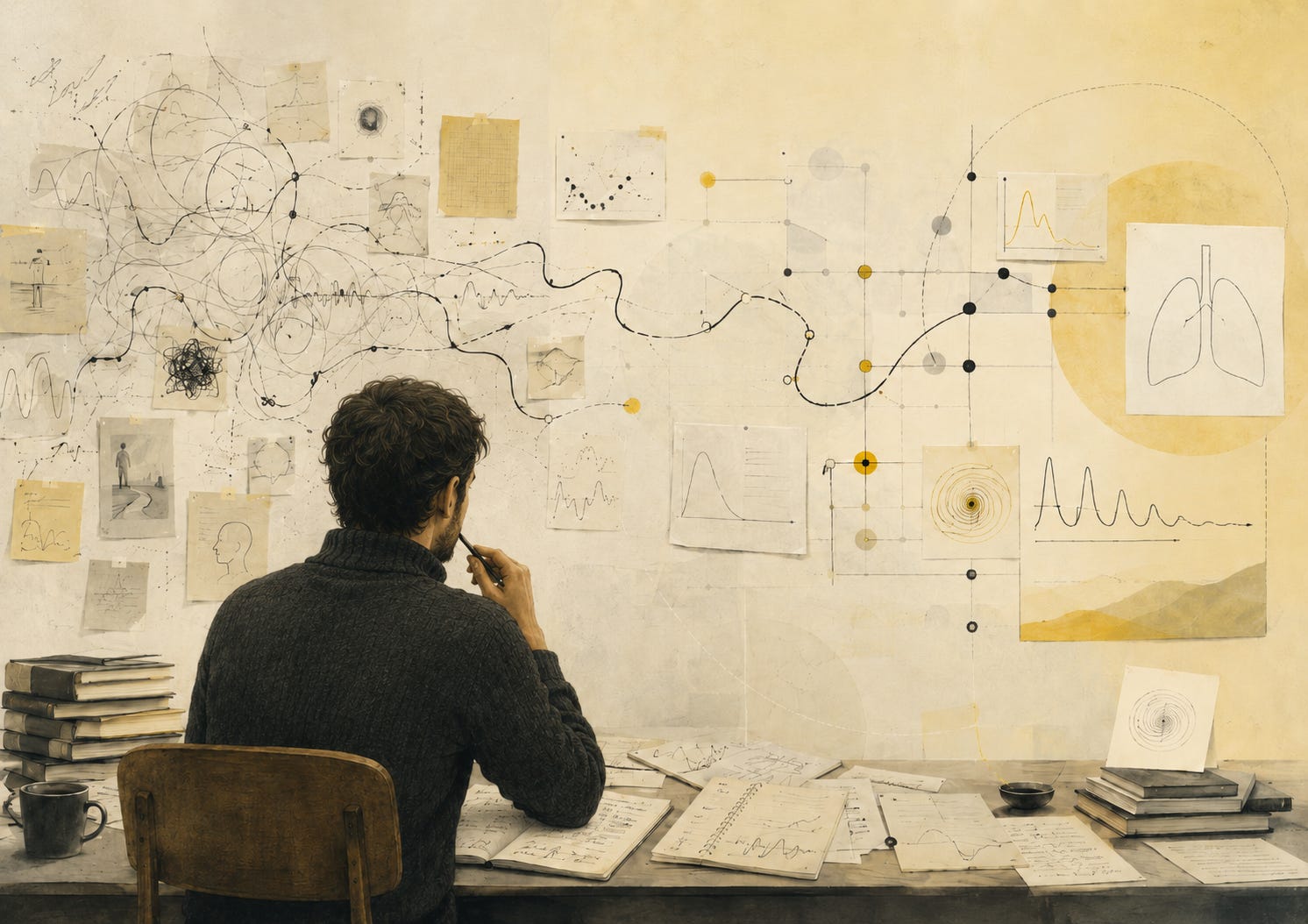
I recently reread David Brooks’ essay “You Might Be a Late Bloomer” in The Atlantic.
What stayed with me was the temperament Brooks describes: the kind of person who does not move cleanly through the usual systems of achievement, but keeps circling a problem until it finally begins to take shape.
He describes people who are not especially good at following the expected path. People who wander, resist, self-teach, start over, and eventually discover that the thing they could not stop thinking about was the work.
The word that stayed with me was inquiétude.
I don’t want to overstate the connection. Brooks is writing about Cézanne and late-life achievement. I’m writing from a much smaller place: years of noticing the same kinds of problems in pulmonary function testing and not having a good way to organize them.
But the word helped because it names something I recognize: not inspiration, and not ambition, but the persistent discomfort of seeing a pattern before you can explain it well.
That was the early stage of the Apparent Certainty Framework for me.
I had observations, examples, objections, and instincts. What I did not yet have was a structure.
For a long time, that made the whole thing difficult to talk about. I could point to cases. I could describe situations. I could say, “This looks more certain than it should.” But I could not yet show the larger shape of the problem.
So the work kept circling.
Quality assurance. Standards. Reporting. Interpretation. Technologist practice. Physiologic variability. The difference between what a test process contains and what a final result preserves.
None of those pieces were separate, exactly. But I also did not yet know how to connect them without flattening them.
That is probably the part of Brooks’ essay that felt most relevant to me: the idea that some people do not arrive at their work by the cleanest route. They accumulate pieces before they know what the pieces are for.
That can look inefficient from the outside.
Sometimes it is inefficient.
But there is a difference between scattered attention and attention that has not yet found its organizing problem.
I think I spent years in that second category.
Brooks also writes about intrinsic motivation. That part matters to me because a lot of this work did not begin with an assignment, an academic program, a grant, or a formal role. It began because certain things kept bothering me.
Not in a dramatic way. More in the practical, recurring sense that the available explanation was not quite enough.
That is a strange position to be in. You can feel strongly that something matters while still being uncertain about how to describe it. You can be right about the presence of a problem and still be wrong, incomplete, or premature in your explanation of it.
That tension has been central to this project.
Brooks describes late bloomers as people who often have to teach themselves. He also points to the combination of a “high need for cognition” and “epistemic humility.”
That combination feels important.
The first part is familiar to me. I am often drawn to problems that seem straightforward until they don’t. I want to understand why the “obvious” explanation does not quite hold. I like the point where categories start to break down and a better structure becomes necessary.
The second part is harder, but probably more important.
Because if you are building something outside a formal pathway, you have to keep asking whether you are clarifying the problem or just becoming more attached to your own explanation.
That is where the Apparent Certainty Framework has been useful for me. It gave me a way to discipline the pattern instead of just reacting to it.
It turned a long-running discomfort into something I could test against examples, revise, and explain.
Not perfectly.
Not finally.
But better than before.
I don’t think the lesson of Brooks’ essay is that late bloomers are secretly superior, or that all wandering eventually becomes wisdom. Some wandering stays wandering. Some intensity is just intensity. Some objections are not insights.
But sometimes a long, inefficient path gives you access to something you probably would not have seen by moving more efficiently.
That is the part I keep thinking about.
The framework did not arrive because I sat down one day and decided to make a framework. It came from years of repeated contact with the same unresolved problem, followed by the slow realization that the problem needed a shape.
That is a different kind of development than I once imagined.
Less like invention.
More like finally organizing what had been accumulating for years.
Brooks quotes Van Gogh: “I am seeking. I am striving.”
That line does not feel triumphant to me.
It feels accurate.
The work is not finished. The framework is not final. I am still revising the language, the model, and my own understanding of what it is trying to show.
But the thing that used to be only a discomfort now has edges.
Not fixed.
Not finished.
But visible enough to work on.